Table of Contents
If you had told someone in 2010 that “digital marketing” would one day be one of the in-demand career paths in the world, they might have given you a skeptical look. Here we are. Businesses of every size. From a bakery to a Fortune 500 company. Now depend on digital marketing to survive and grow. The demand for skilled people in this space is. It looks like the parameters for your blog post (Title, Outline, and Tone of Voice) were left blank in your request.
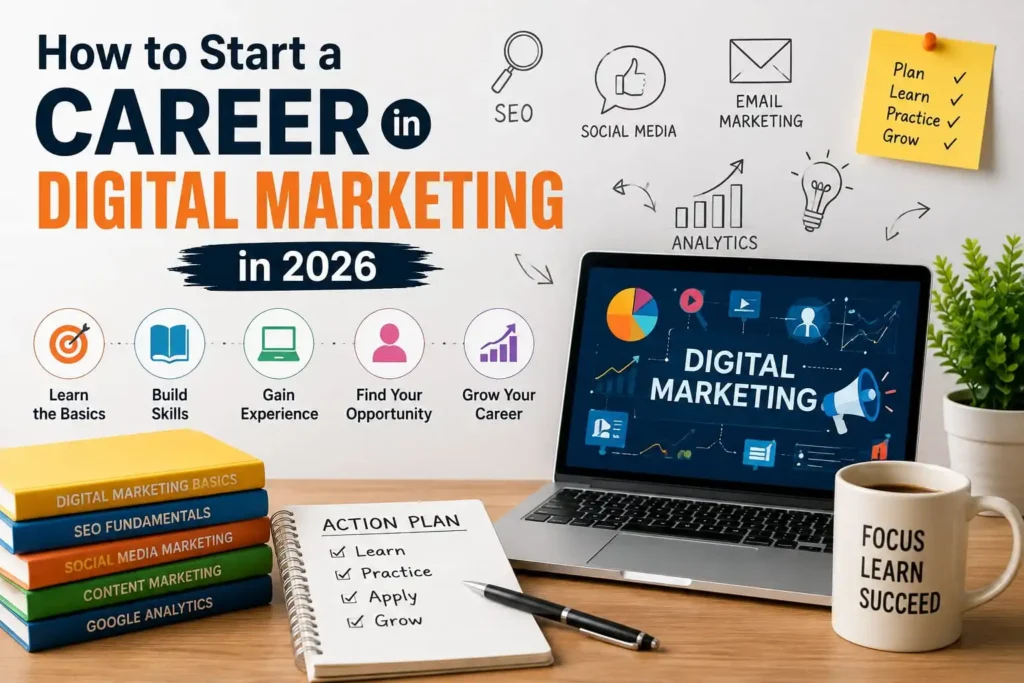
What Does a Career in Digital Marketing Look Like?
Before you start building your resume or signing up for courses, it helps to understand what this career actually involves on a day-to-day basis. A lot of people assume digital marketing is about posting on social media. That is a piece of a much larger picture.
Digital marketing covers everything a business does to promote itself online. That includes:
- * Search engine optimization (SEO). Helping websites show up on Google
- * Content marketing. Writing blogs, making videos, creating guides
- * Media marketing. Managing platforms like Instagram, LinkedIn, or TikTok
- * Email marketing. Building and sending campaigns to subscribers
- * Paid advertising. Running ads on Google, Meta, or other platforms
- * Analytics. Measuring what works and what Doesn’t
- * Affiliate marketing. Promoting products through partner programs
- * Conversion rate optimization. Improving websites to turn visitors into customers
The thing about a career in digital marketing is that you rarely do all of these at once. Most professionals specialize in one or two areas. Become genuinely good at them. A common path is to start learning a little about everything and then find what clicks for you.
Think of marketing like a Swiss Army knife. You just need to pick the ones that suit the job at hand. Get very good at those
Why 2026 Is Actually a Great Time to Start
Some people worry they have “missed the window” for getting into digital marketing. They feel like it is too crowded or too competitive now. Honestly? That concern is understandable. But it is also a bit misplaced. Starting a career in digital marketing in 2026 can still be a great choice for people who are willing to learn. Practice and keep up with the changing industry.
Digital Marketing Growth Shows No Signs of Slowing Down
The numbers tell a clear story. Global digital advertising spending is expected to surpass $870 billion by 2026, according to industry projections. More spending means campaigns, more content, more strategy. And a greater need for human talent to make it all happen.
It is also worth noting that many businesses, small and medium-sized ones, still lack a proper digital marketing strategy. They know they need one. They either do not have the time or the people to do it.
AI Changed the Game. Humans Still Drive It
There is a conversation happening right now in every marketing team around the world: “Will AI replace digital marketers?” The short answer is no. The longer answer is that AI has changed what digital marketers do, not whether they are needed.
In 2026, tools powered by intelligence can write first drafts of blog posts, generate ad copy variations, analyze data at incredible speed, and suggest content ideas. Someone still needs to:
* Decide the strategy behind the content
* Review and edit AI-generated work for accuracy and brand voice
* Build relationships with audiences and partners
* Interpret data and make judgment calls
* Understand the side of buyer behavior
If anything, AI has made digital marketing faster and more accessible, which means businesses can do more of it. And they need more people who understand how to guide those tools effectively.
Opportunities in Digital Marketing Are More Diverse Than Ever
One thing that genuinely surprises people when they look closer at opportunities in marketing is how many different types of roles exist. You do not have to be a media influencer or a tech genius to make it work. There are roles for:
- * Writers and storytellers (content strategists, copywriters)
- * Analytical thinkers (SEO specialists, data analysts, PPC managers)
- * Creative types ( designers, video editors, brand strategists)
- * People who love building relationships (influencer managers, PR specialists)
- * Tech-oriented professionals (marketing automation experts, developers who understand conversion)
This is genuinely one of the career fields where introverts and extroverts, creative people and logical people all find a natural home.
The Digital Marketing Skills You Actually Need in 2026
Here is where a lot of career guides go wrong. They give you a list of skills and leave you feeling overwhelmed. Instead, let us talk about what matters and why.
Core Digital Marketing Skills to Build First
Think of these as your foundation. Before you specialize, you want a working knowledge of:
1. SEO (Search Engine Optimization)
Understanding how search engines work and how to help content rank higher is one of the durable skills in digital marketing. Search is not going anywhere. Even as AI tools change how people search, businesses still desperately need their content to be found. Learning the basics of keyword research, on-page optimization, and link building will serve you for years.
2. Content Creation and Writing
Writing is still the backbone of almost every digital marketing channel. Whether it is an email, a media caption, a landing page, or a blog post. Words matter. If you can write clearly in a way that actually connects with real people, you already have a significant advantage.
3.. Analytics
You do not need to be a data scientist. You do need to be comfortable looking at a Google Analytics report or a social media dashboard and understanding what the numbers are telling you. Marketing without measurement is guesswork. Businesses know this now more than ever.
4. Paid Advertising Basics
Even if you do not plan to run ads as your job, understanding how platforms like Google Ads or Meta Ads work will make you a much more effective marketer overall. Knowing how paid and organic strategies interact is genuinely valuable.
5. Email Marketing
Email consistently delivers some of the returns of any digital channel. Learning how to build an email list, write campaigns, and understand open rates and click-through rates is a skill that will keep you employable.
Skills That Are Becoming More Important in 2026
Beyond the basics, here are the areas gaining momentum:
- * Prompt engineering: knowing how to talk to AI tools to get output
- * Video content creation- short-form video is not a trend; it is a default format now
- * Marketing automation. Setting up systems that nurture leads without constant manual work
- * First-party data strategy. As cookies disappear, understanding how to collect and use your data ethically is a growing priority
- * Community building. Brands are investing more in building real communities, not just follower counts
Soft Skills That Often Get Overlooked
Here is something I feel strongly about: digital marketing is as much a people skill as it is a technical one. The effective marketers I have ever seen are not necessarily the ones who know every tool. They are the ones who:
- * Can think from the customer’s perspective
- * Communicate ideas clearly to teams and clients
- * Stay curious. Keep learning without being told to
- * Can handle feedback and adjust without taking it personally
- * Manage their time well when working independently or remotely
These things are harder to teach than technical skills, but they make an enormous difference in how far you go in your career.
How to Start Building Your Career in Digital Marketing Step by Step
Knowing what digital marketing involves is one thing. Actually getting started is another. Here is a practical roadmap to help you begin a career in digital marketing. Whether you have zero experience or a few years in the field.
Step 1: Learn the Fundamentals Through Paid Resources
You do not need an expensive degree to get started. Some of the respected training in this field is free or very affordable.
- * Google Digital Garage. Certifications covering SEO, ads, analytics, and more
- * HubSpot Academy— free courses on content marketing, email, inbound strategy
- * Google Analytics Certification. Free and genuinely useful for any marketing role
- * Meta Blueprint. Training on Facebook and Instagram advertising
- * Coursera and LinkedIn Learning. Paid but often affordable with structured courses
If I were starting fresh today, I would begin with Google’s free courses and HubSpot Academy. They are well-structured, respected by employers, and give you a working vocabulary for the field quickly.
Step 2: Build Something Real. Even If It Is Small
This is the step most people skip. It is the most important one. Reading about SEO is very different from trying to rank a piece of content. Understanding media in theory is very different from managing an account and watching what works.
Start a project. It does not have to be impressive. Some ideas:
- * Start a blog on a topic you truly care about and try to grow its traffic
- * Create a social media account around a niche interest and experiment with content
- * Volunteer to help a local business or nonprofit with their digital presence
- * Build an email newsletter using a free tool like Mailchimp or Beehiiv
The goal is not to make money right away. The goal is to have something to show and learn from. When you sit down for a job interview. Can say, “I ran this Instagram account and grew it from 0 to 800 followers in three months by testing these content formats,” that is infinitely more compelling than just a list of courses on your resume.
Step 3: Pick a Specialization. Go Deeper
Once you have a basic understanding of the landscape, pick one area and go deeper. This is where most career digital marketers get stuck. They keep learning a little about everything and never become genuinely good at one thing.
Ask yourself:
- * What type of work felt most natural when you were experimenting?
- * What kind of results do you find satisfying to produce?
- * Where do you see the job opportunities in your market?
Some good starting specializations for 2026:
- * SEO specialist. Demand, clear skill path, measurable results
- * Social media manager. Good entry point, lots of opportunities especially for small businesses
- * Paid media specialist (PPC). Earning potential is very data-driven
- * Email marketing specialist. High demand across industries
- * Content writer/strategist. Works well for people with writing backgrounds
Step 4: Get Your First Experience (Even If It Is Unpaid)
The “experience paradox”. You need experience to get a job, but you need a job to get experience. Is real in digital marketing just like everywhere else. Here is how to work around it:
- * Freelance on projects. Platforms like Fiverr or Upwork have entry-level gigs that let you build a portfolio
- * Intern with an agency or startup. Even a short internship gives you real-world context
- * Offer your skills to someone you know— help a friend’s business or a community organization
- * Create case studies from your projects. Document what you did, what happened, and what you learned
The key is to treat every small project like it matters because it does. Not just for the client but for your own learning curve.
Step 5: Build Your Online Presence
It may sound a little ironic. Many aspiring digital marketers have very little digital presence themselves. If you want to convince someone that you can build their visibility, it helps to have at least a basic online footprint.
At minimum:
- * Have an up-to-date LinkedIn profile with a clear description of your skills and interests
- * Consider a simple personal website or portfolio page where you showcase your work
- * Start sharing content related to marketing. Your learnings, experiments, opinions
- * Engage with communities in your area of interest (LinkedIn groups, Reddit communities, industry newsletters)
This is not about becoming a social media personality. It is about showing that you understand how online presence works by practicing it.
Step 6: Apply, Apply, and Keep Refining
Your first application will probably not land. That is completely normal. The goal of applications is as much about learning what employers are looking for as it is about getting the job.
When applying:
- * Tailor your resume and cover letter to each role. Generic applications rarely work
- * Use job descriptions to identify skill gaps and go fill them
- * Apply to companies and agencies first. They often give junior marketers more responsibility and learning opportunities
- * Do not be discouraged by silence. Follow up once politely. Move on
Getting your first role in digital marketing usually takes more time than people expect. That is not a sign you are doing it wrong. It is the reality of a competitive but very rewarding path.
What Types of Roles Can You Get?
Let us look at job titles you might be applying for at the start of your career in digital marketing. These roles can be good starting points for a career in digital marketing.
Entry-Level Roles
- * Digital Marketing Assistant— support across channels good for learning
- * Social Media Coordinator. Managing content calendars and posting schedules
- * SEO Junior Specialist— keyword research, content optimization, reporting
- * Content Writer. Producing blog posts, website copy, or email content
- * PPC Analyst. Supporting paid ad campaigns with data entry and reporting
- * Email Marketing Coordinator. Building and sending campaigns, managing lists
Mid-Level Roles (Where You Head After 2–3 Years)
- SEO Manager
- Social Media Manager
- Content Marketing Manager
- Paid Media Manager
- Marketing Analyst
- Digital Marketing Specialist
Senior and Leadership Roles (Longer Term)
- * Digital Marketing Manager
- * Head of Growth
- * VP of Marketing
- * Chief Marketing Officer (CMO)
- * Marketing Director
You can also choose to go the freelance or agency route rather than working in-house. Many digital marketers find that working with clients at an agency or building their own client roster as a freelancer suits them better than a single employer setup.
Where to Find Opportunities in Digital Marketing
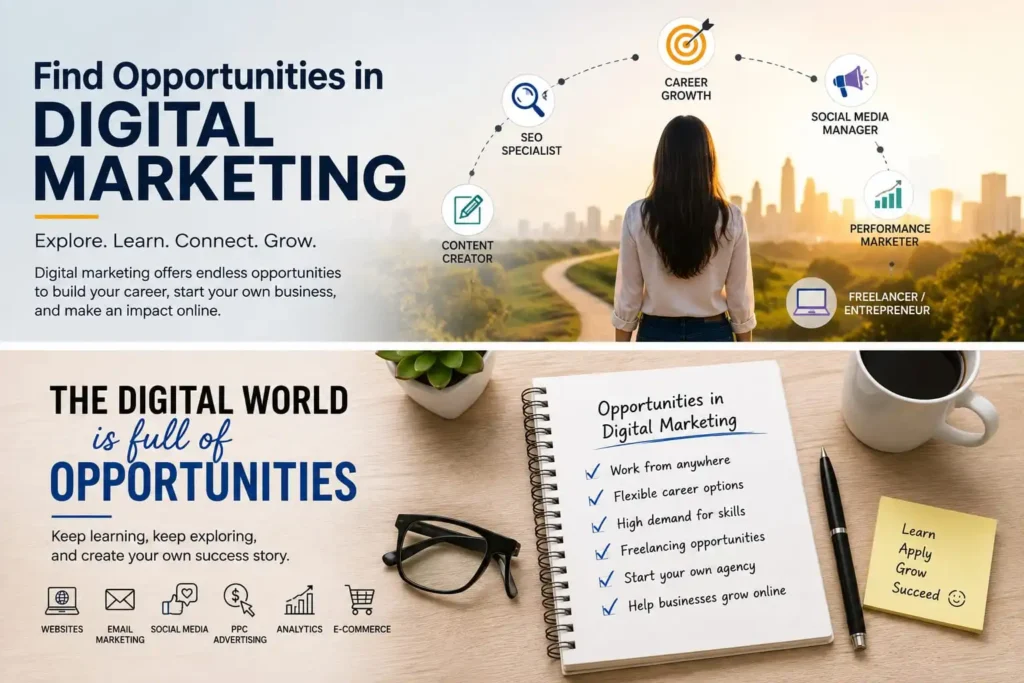
Knowing where to look is almost as important as knowing what to look for when building a career in digital marketing.
Job Boards That Work Well for Digital Marketing Roles
- * LinkedIn. The active platform for professional job listings
- * Indeed. Broad reach, good for entry-level positions
- * We Work Remotely. Great if you’re open to remote roles
- * Remote.co— similar to We Work Remotely
- * Marketing Week Jobs (UK-focused). Strong for marketing roles
- * Glassdoor. Useful for research on company culture and salaries alongside job listings
Networking (Yes It Matters)
In 2026, your network matters as much as it ever did. Maybe more. A significant portion of jobs, good ones, are filled through referrals and personal connections before they even get posted publicly.
Ways to build your network in marketing:
- * Attend local marketing meetups or digital marketing events
- * Join industry communities on LinkedIn, Discord, or Slack
- * Comment thoughtfully on content posted by professionals you admire
- * Reach out to people in roles you want and ask for a 15-minute conversation. More people say yes than you would expect
- * Connect with peers going through the same learning journey. They are your future colleagues
Agencies vs. In-House vs. Freelance
These three paths feel very different in practice, and it is worth thinking about which suits your working style. Each path offers a different way to develop a career in digital marketing.
Agency life
- * Fast-paced and varied
- * You work across clients and industries
- * Great for learning
- * Can be intense, especially in smaller agencies
In-house (working for one company)
- * Deeper understanding of one brand and audience
- * More structured hours and processes
- * Career growth tied to one organization’s trajectory
- * Good for people who like consistency
Freelance
- * Full control of your time and clients
- * Higher earning potential once established
- * Requires self-discipline and business development skills
- * Income can be unpredictable early on
Most people find their way eventually. Many start at an agency to learn, move in-house for stability, and then explore freelancing once they have the confidence and connections to do it.
Common Mistakes to Avoid When Starting Out
Having watched people navigate this path, a few patterns come up again and again when it comes to mistakes people make while starting a career in digital marketing:
- * Waiting until you feel “ready”. You never fully feel ready. Start anyway.
- * Learning without doing. Courses are only useful if they lead to practice
- * Trying to learn everything at once. Pick a lane. Go deep before going wide
- * Undervaluing analytics— many creatives avoid data. It is the thing that separates good marketers from great ones
- * Copying job applications. Generic CVs get ignored. Tailored ones get noticed.
- * Ignoring your presence— if you want to market others, show that you can market yourself
- * Giving up too early. The first few months of any career change feel slow and discouraging. That is normal.
A Realistic Timeline for Getting Started
Everyone’s path looks different. Here is a rough sense of what a realistic journey can look like. This timeline can help beginners understand what starting a career in digital marketing may look like.
Months 1–2: Learning fundamentals, completing free certifications, starting a small personal project
Months 3–4: Building a portfolio, doing small freelance projects or volunteering, going deeper on one specialization
Months 5–6: Actively applying for entry-level roles, refining your resume, networking, continuing to learn
Months 7–12: Landing your first role or consistent freelance work, learning on the job, identifying areas to grow
Year 2–3:Building a track record of real results, taking on more responsibility, possibly specializing further or moving to a higher-level role
This is not a promise. Some people move faster, some slower. If you stay consistent and focus on real practice rather than just theory, this kind of timeline is entirely achievable.
Conclusion
A career in marketing in 2026 is very much within reach for anyone willing to put in the time to learn, practice, and stay curious. The field rewards people who’re genuinely interested in understanding how people think, what they respond to, and how businesses grow.
The tools will keep changing. The platforms will. Go. What will not change is the need for people who can combine thinking, creativity, and an understanding of human behavior to help businesses connect with the right people.
You don’t need a background. You don’t need to have taken marketing classes in school. What you need is a dedication to learning. And the patience to let that learning grow over time.
Start small. Keep going every day. Concentrate on gaining skills, not just putting certificates on your LinkedIn page. Keep in mind that every person who is good at this started exactly where you are now.
The best time to begin your career in marketing was five years ago. The next best time is now. So go begin. Starting a career in digital marketing in 2026 is possible with consistent learning and practical experience.
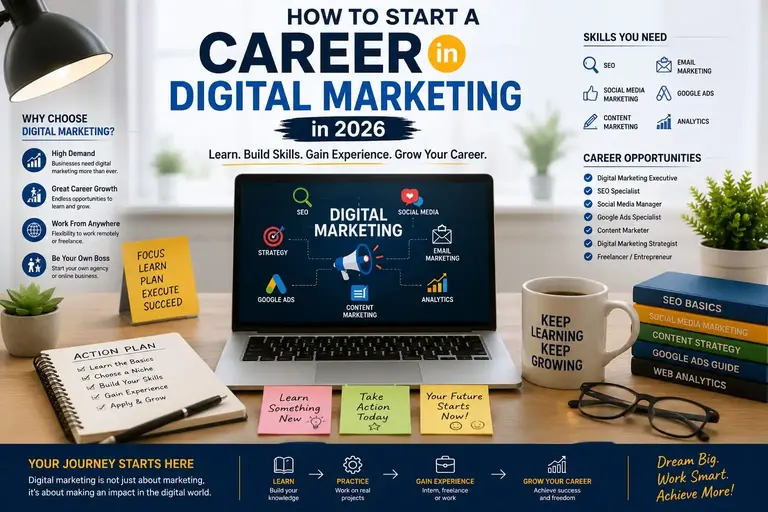
If you need a service related to this, you can connect with a Digital Marketing Professional in Thrissur.