Table of Contents
Introduction
Content marketing can take many forms such as blogs, social media posts, videos, infographics, and emails. However, without a proper strategy in place, it can yield disappointing results. A content marketing strategy is therefore crucial in any successful business.
In this article, you will learn how to create a content marketing strategy for beginners, including the simple steps and essential tips.
What Is a Content Marketing Strategy?
A content marketing strategy involves developing and implementing a scheme of creating and distributing valuable and informative content to your target audience to meet your marketing objectives.
A company that offers digital marketing services may, for instance, use SEO blogs, Instagram posts, and video marketing to acquire new clients and increase website traffic. A powerful marketing strategy works by ensuring that all content created serves a specific marketing purpose.
Why Is a Content Marketing Strategy Important?
Below are some of the primary reasons why every business needs a content marketing strategy:
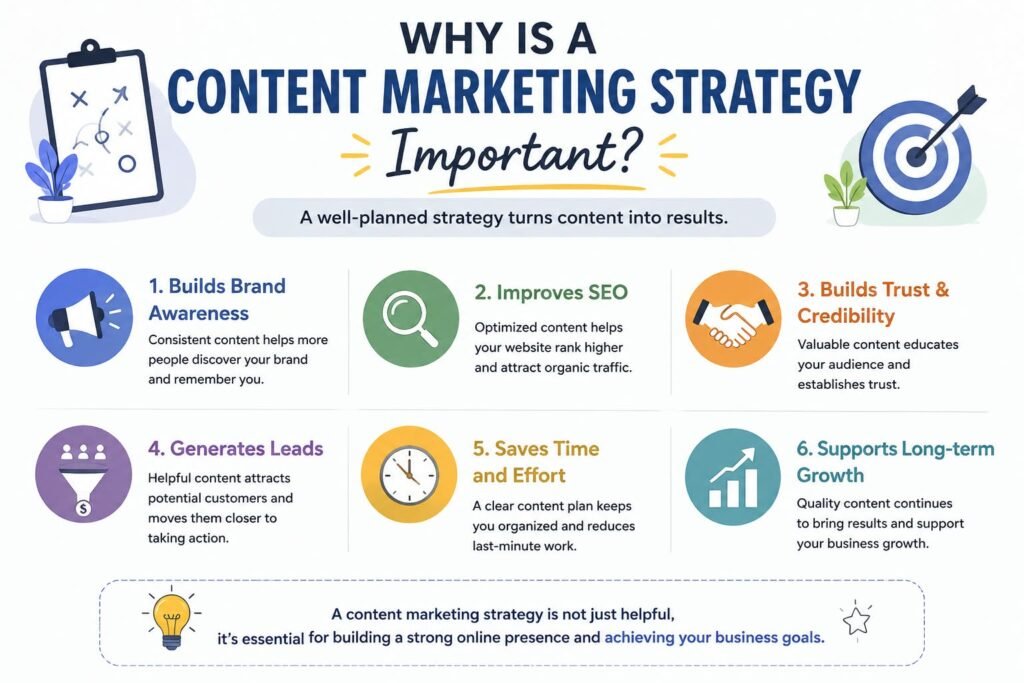
1. Boosts Brand Awareness
Publishing valuable content provides an opportunity to reach a wide audience and improve your brand’s online presence.
2. Enhances SEO
Creating and publishing SEO-friendly blog posts is an effective way to improve your website’s ranking on search engines.
3. Increases Website Traffic
Valuable content can aid in attracting a larger audience, including potential customers, to your website and boosting sales.
4. Builds Brand Credibility
Publishing informative articles and videos provides a chance to establish authority in your niche and support customers in making informed decisions.
5. Drives Leads
Many businesses rely on content marketing to attract potential customers and find new sales opportunities. For instance, business owners can entice potential clients with free guides and newsletters and encourage them to buy their products or services.
6. Saves Time
With a proper content marketing plan, you can stay organized and focused on achieving your marketing objectives. A content strategy also helps you avoid running out of ideas at some point and having to rush to come up with new content
A Beginner’s Guide to Building a Content Marketing Strategy for Beginners
Follow the tips below to come up with a powerful content marketing strategy as a beginner:
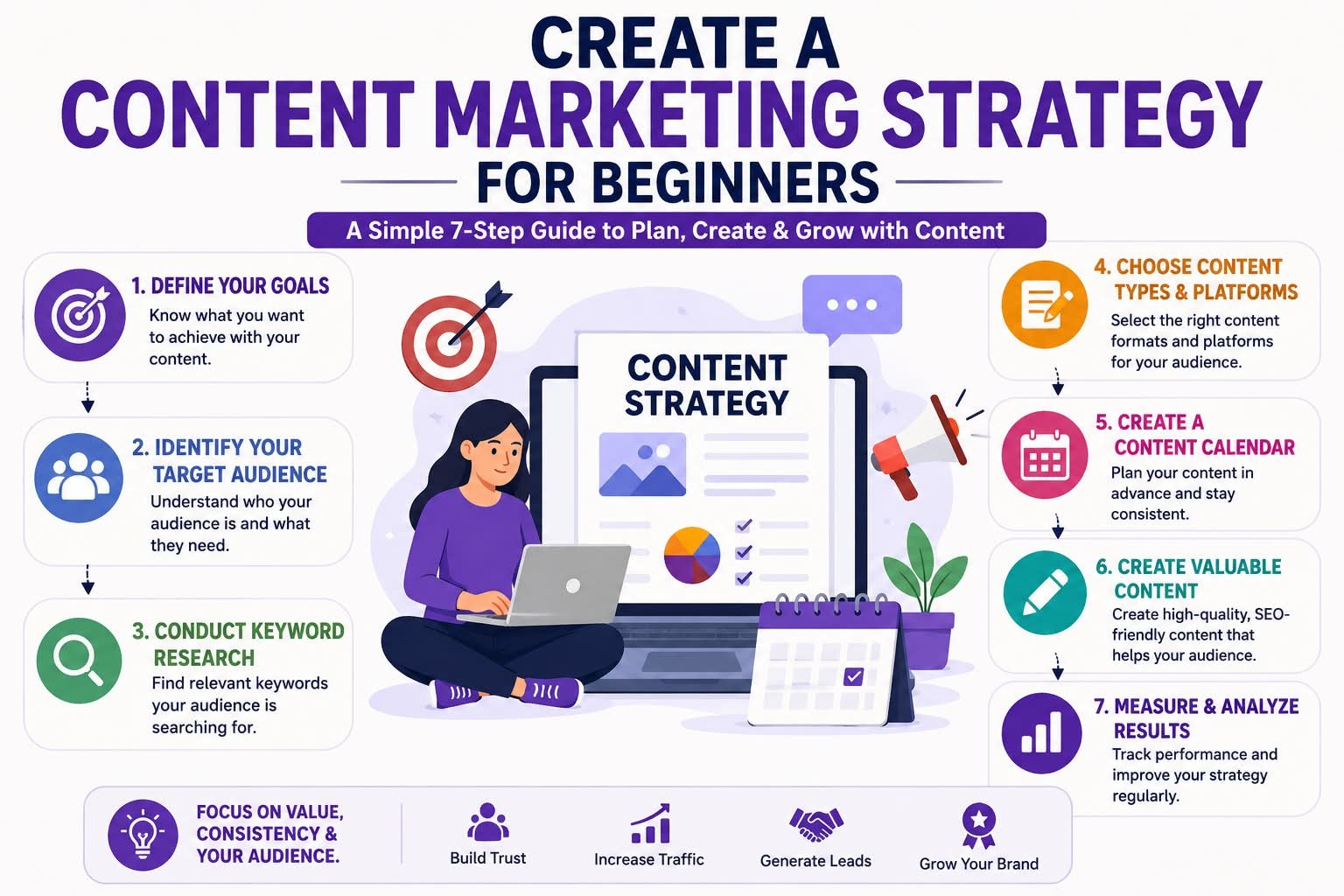
Step 1: Define Your Content Marketing Objectives
The first step in developing a content marketing strategy is to establish your objectives. As a beginner, it is essential to set realistic goals. Your marketing objectives should, however, be measurable so that you can monitor your progress and determine what works and what doesn’t.
Some common content marketing objectives include:
- • Driving more traffic
- • Enhancing brand awareness
- • Generating more leads
- • Increasing sales
- • Improving social media engagement
- • Boosting your website’s SEO
Your content marketing objective will play a critical role in determining the type of content you will create.
Step 2: Understand Your Target Audience
Your target audience is a group of people who are more likely to be interested in your business. To identify your audience, you need to carry out some research to understand their wants, needs, and pain points.
Other factors to consider about your target audience include:
- • The platforms they frequent
- • Preferred content types
- • The issue they want to address.
For instance, if your target audience is beginners in digital marketing, you may create blog posts and video content on SEO basics, content marketing, social media marketing, and keyword research.
Step 3: Conduct Keyword Research
Conducting keyword research is essential if you plan to blog or optimize existing content. These tools can help you understand your audience’s needs and find relevant keywords.
You could research keywords such as:
• Content marketing strategy
• Content marketing for beginners
• How to create a content strategy
• Content marketing tips
• Content planning
Choose keywords relevant to your target audience. You can, for instance, pick keywords with high search volume and low competition. Always remember to use your primary keyword, especially in the title, introduction, and conclusion, while incorporating other related keywords throughout the content. However, avoid overusing keywords as it may hurt your SEO efforts.
Step 4: Choose the Most Appropriate Content Formats and Channels
At this point, you should have identified your marketing objectives, target audience, and keywords. You can now decide on the most suitable content marketing channels and formats.
Some popular content marketing formats and channels include:
Blog Posts – These are informative articles that are beneficial for SEO and attracting organic traffic.
Social Media Posts – They are effective in enhancing brand awareness and encouraging engagement among your target audience.
Videos – This format is appropriate when you need to simplify a particular topic or teach your audience a new skill.
Email Newsletters –can attract potential customers to your website and keep them informed about your products or services.
Infographics – They use visuals to present information, data, and processes clearly and attractively.
Choose content formats and platforms based on your target audience’s preferences. For example, social media posts may be more effective than email newsletters when targeting young people.
Choose the content types and channels your target audience prefers most. For instance, if your target audience is young people, it would make more sense to invest your time and effort in social media posts rather than email newsletters.
Step 5: Create a Powerful Content Marketing Calendar
A content marketing calendar is a powerful tool that helps you organize your content and meet your content marketing objectives. It will also help you ensure that your content is published regularly and that you do not run out of ideas. Your content marketing calendar should be easy to read and include the following details:
- • Content topic
- • Target keywords
- • Content formats
- • Channels
- • Date of publication
- • Status of the content
As a beginner, it may be overwhelming to create content on a weekly basis. You can, therefore, start by publishing one blog post and three social media posts in a week. A sample content calendar may look like this:
Day Content Topic Platform
Monday Content marketing basics Blog
Wednesday Content marketing tips Instagram
Friday Common content marketing mistakes LinkedIn
Step 6: Publish Powerful and SEO-Friendly Content
At this stage, you should have your content marketing plan ready and can start creating content. Your content should be informative, provide solutions to your audience’s problems or answer their questions, and include relevant keywords. Below are some tips to help:
• Use attractive subheadings and a strong introduction and conclusion
• Ensure that your content is scannable
• Add examples when providing solutions or explaining certain terms
• Use visuals to make your content more interesting
• Make use of internal links to other relevant pages on your website
• Always proofread your content to ensure that it is error-free before publication
When writing a blog post, for instance, always start by coming up with a strong introduction. You should then go ahead and elaborate on the topic while making sure that the paragraphs are easy to read and understand. Conclude by reiterating the key points made in the blog post. Bear in mind that quality outranks quantity when it comes to content creation.
Step 7: Monitor and Evaluate Your Marketing Results
After publishing your content, it is essential to track and analyze your results to determine what is working and what is not. Some of the essential metrics to analyze and track include impressions, traffic, engagement rate, conversion rate, and leads generated.
Google Analytics 4 and Google Search Console are powerful tools you can use to monitor your content performance. Once you have monitored the results, you should go ahead and tweak your content marketing strategy. For instance, if your blog post’s impressions are deep, but the
click-through rate is low, it probably has something to do with the title and meta description, so you may want to go ahead and optimize them.
Common Content Marketing Mistakes That Beginners Should Avoid
Below are some common content marketing mistakes that beginners should avoid:
1. Failing to have specific goals – Always set realistic and specific goals when creating content.
2. Creating content without keeping your target audience in mind – Your content should address the needs and wants of your target audience.
3. Keyword stuffing – Always include keywords organically in your content.
4. Inconsistent content creation – It is important to develop a content marketing calendar and adhere to the schedule as much as possible.
5. Not measuring and analyzing the results – Always monitor the impact your content is making and keep tweaking your strategy to meet your objectives.
6. Expecting fast results – Content marketing is a long-term game, and you should not expect rapid results.
Conclusion
From the discussion above, it is evident that developing a content marketing strategy is not as difficult as it seems. It largely boils down to knowing your target audience, investing time in conducting research, and using the right tools.
Always start small and focus on providing valuable information to your target audience. It is also essential to measure the impact of your content and tweak your strategy for continuous improvement.

Frequently Asked Questions (FAQs)
1. What is a content marketing strategy?
A content marketing strategy is a scheme that entails developing and distributing valuable and informative content to your target audience to meet your marketing objectives.
2. How can one start doing content marketing?
To start content marketing, you need to set realistic and specific goals, conduct audience and keyword research, set up the necessary tools, choose the appropriate content types and channels, and create a content marketing calendar.
3. What tools are essential for content marketing?
Some of the tools essential for content marketing include Canva, Google Sheets, Google Trends, Google Keyword Planner, Google Search Console, and Google Analytics 4.
4. How often should one publish content?
Your content marketing frequency largely depends on your objectives and available time. However, it is important to ensure consistency.
5. How long will it take before content marketing starts yielding results?
The time it takes for content marketing to bear fruit will depend on your niche, SEO strategy, target audience, and other related factors.
If you need a service related to this, you can connect with a Digital Marketing professional in Thrissur